

 English
 Español
 عربى
عربىWhat is WPC Flooring and Why Manufacturers Choose Factory Direct Sourcing When searching for reliable flooring solutions, procurement professionals a...
READ MORE
Clean air, a human right
Choosing between MDF and wood wall panels is rarely a simple preference for one material over the other. The right choice depends on the room, the climate, the finish you want, and the amount of maintenance you can accept. Medium-density fiberboard (MDF) offers a flat and predictable surface that paints beautifully. Wood brings a natural grain, depth, and a degree of movement that needs to be managed during installation. Understanding the difference between MDF and wood wall panels is therefore the first step toward a durable, good-looking wall that fits your budget.
MDF is an engineered wood product manufactured by breaking hardwood and softwood residuals down into fine fibers. Those fibers are mixed with synthetic resin and wax, then formed into dense panels under high pressure and temperature. Because the process removes natural defects, MDF has no grain, knots, or voids, which makes its internal structure extremely consistent.
Wall panels made from MDF are usually sold in large sheets, most commonly 2440 by 1220 millimetres and between 12 and 18 millimetres thick, though custom dimensions are also produced. Builders use them for accent walls, slat wall systems, wainscoting, and fully painted feature walls. You will often find an MDF core behind wood veneer panels, because the smooth substrate keeps the thin veneer flat and reduces telegraphing of rough structure.
Key characteristics of MDF wall panels:
The main weakness appears when water is involved. MDF has no protective bark or resin layer, and prolonged wetting can cause irreversible edge swelling that is extremely difficult to repair.
Solid wood wall panels come in several forms: solid timber boards, tongue-and-groove planks, shiplap profiles, and engineered panels with a natural wood veneer over a stable core. Solid timber retains all the character of the tree, including grain direction, colour variation, knots, and surface texture that responds to the surrounding air.
Wood panels behave like a living material. They take on moisture when the air is humid and release it when the air is dry, which causes the board to expand and contract across the grain. A 150-millimetre-wide board can change its width by roughly 1 to 2 percent between summer and winter. Experienced installers plan for this movement with expansion gaps, flexible sealants, and careful orientation of the boards.
Advantages that wood wall panels bring to a project:
The cost of wood is higher than MDF, and the maintenance responsibility is heavier, but many homeowners accept that trade-off for a material that can be sanded, repaired, and refinished for decades.
The table below condenses the essential differences between MDF and wood wall panels for a typical interior wall application.
| Attribute | MDF Wall Panel | Wood Wall Panel |
|---|---|---|
| Composition | Wood fibers, resin, and wax | Natural solid timber |
| Surface | Smooth with no grain | Visible grain and knots |
| Moisture response | Swells permanently when soaked | Expands and contracts with humidity |
| Screw holding | Good face grip, splits near edges | Excellent, can be re-drilled |
| Impact resistance | Prone to dents and scratches | Better resistance to impact |
| Paint finish | Excellent, hides grain completely | Good, grain remains visible |
| Stain finish | Not suitable | Excellent |
| Repair potential | Difficult after swelling | Sand and refinish |
| Typical service life | 10 to 25 years in dry conditions | 30 to 50 years with care |
| Relative cost | Lower material price | Higher material price |
| Best use | Interior painted walls | Feature walls and paneling |
The biggest practical difference between MDF and wood wall panels shows up when humidity enters the scene. MDF swells in thickness when moisture penetrates an unprotected edge or an unsealed cut surface. Once the fibers absorb water, the board does not return to its original shape; it leaves a permanent bulge at the bottom of a wall, around power outlets, or along window reveals. Even high-quality MDF will fail quickly if it sits in standing water.
Wood behaves more predictably because its cellular structure allows moisture to move in and out. A properly acclimated wood panel will expand and contract across the grain, and that movement can be managed with gaps and flexible sealants. In a very humid room such as a bathroom, both materials need a moisture barrier or a more stable alternative such as a wood-plastic composite panel.
Solid wood has a higher stiffness-to-weight ratio than MDF, which means a wood board of equal thickness resists bending better. MDF is more consistent because it has no knots or weak zones, but it tends to split when fasteners are placed close to the edges. Every screw or nail in an MDF panel should be preceded by a pilot hole. Wood accepts screws and nails more forgivingly, and a fastener can often be moved and re-driven without losing grip.
Key takeaway: MDF fails dramatically under constant water, while wood expands and contracts but can be dried, sanded, and refinished to recover from minor moisture damage.
MDF is frequently specified for paint-grade work. Because the board is homogeneous and grain-free, a sprayed or roller-applied paint dries to a flat, blemish-free surface. This is a major reason MDF is preferred for modern slat walls, large-format painted panels, and feature walls where seamless colour is required. The factory-calendered surface also takes primer well, reducing the number of coats needed to hide patch repairs.
Wood offers a completely different visual language. Stains and oils penetrate the grain and create warm contrast between earlywood and latewood. A clear lacquer highlights the natural texture of the timber and deepens its colour over time. If you decide to paint a wood wall, the grain will still telegraph through the paint film unless you apply heavy primers and multiple coats, which adds time and material cost.
Long-term appearance also differs. Wood surfaces can be sanded lightly to remove small scratches, then re-oiled or re-lacquered to restore a uniform sheen. MDF surfaces are softer and less forgiving; a deep scratch exposes the fibrous structure and is very difficult to blend. Damaged MDF panels often require patching, re-priming, and repainting rather than simple local refinishing.
Cutting MDF produces a very fine dust that contains resin particles and can irritate the respiratory system. A dust mask and a saw connected to a vacuum are strongly recommended. All cut edges must be sealed before painting, especially if the panel will be installed in a zone where humidity can reach the substrate. Wood cuts more cleanly, but requires sharp blades to avoid tear-out along the grain.
Fastening is another point of separation. MDF holds screws well in the face of the board but can split near an edge unless a pilot hole is drilled. Solid wood can be nailed or screwed without pre-drilling in most softwood species, though dense hardwoods benefit from pilot holes. For heavy wall-mounted elements, solid wood gives more confidence in the long-term holding power of the fastener.
MDF material generally costs 30 to 50 percent less than a comparable solid wood panel. However, the installed cost of an MDF wall may include more paint coats, seam filler, and edge sealing. Wood panels carry a higher material price, but a well-maintained wood wall can be refinished several times, effectively extending its useful life far beyond a typical painted MDF installation. Over a full lifecycle in a dry interior, the total cost gap narrows significantly.
MDF is frequently promoted as a recycling solution because it uses wood waste and sawmill byproducts that would otherwise be discarded. That is a genuine benefit, but the resins used to bond the fibers can release formaldehyde into indoor air. Many manufacturers now produce low-emission MDF that meets strict indoor air quality standards, so buyers should verify the emission certification rather than assume that all MDF is the same.
Solid wood stores carbon for as long as it remains in the building. Its environmental impact is determined almost entirely by the origin of the timber. Sustainably harvested wood from certified forests can be a very low-impact choice, while wood from poorly managed logging operations has the opposite effect. For indoor air quality, natural oiled wood generally emits fewer volatile organic compounds than a painted MDF wall, especially during the first weeks after installation.
At the end of its service life, MDF is difficult to recycle because the fibers are embedded in resin; most panels end up in landfill or energy recovery. Clean solid wood can be reused in smaller projects, chipped for boards, or composted after removing finishes. For a wall that is expected to stay in place for decades, the long-term environmental ledger often favours wood.
In high-moisture environments where neither MDF nor raw wood performs ideally, wood-plastic composite (WPC) panels offer a middle path. WPC combines wood fibres or wood powder with thermoplastic polymers to create a board that looks similar to timber but resists water absorption, rot, and insect attack. Because WPC is formulated for outdoor and semi-outdoor walls, it avoids the swelling problem of MDF and the constant expansion cycles of raw wood.
Modern WPC wall panels use co-extruded surface layers that improve UV stability, scratch resistance, and colour retention. The surface usually mimics wood grain but requires no painting, staining, or sealing. For exterior feature walls, balcony cladding, and commercial facades, WPC is becoming the preferred alternative. Designers follow the development of embossed composite wall cladding closely because surface engineering continues to push panel performance further.
When the wall panel must deliver both the warmth of wood and reliable waterproofing, a first-generation WPC wall panel is often the right specification.
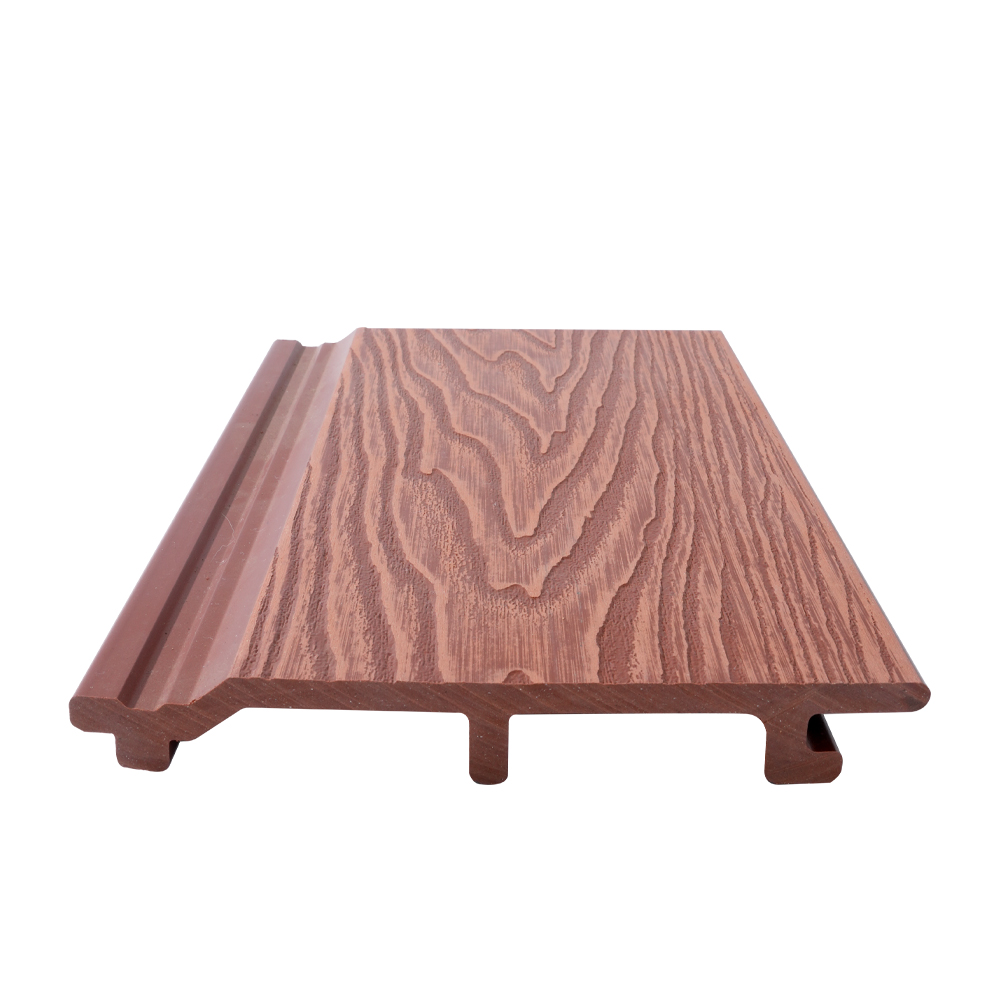 First Generation WPC Wall Panel with Embossed TextureThis wood-plastic composite panel combines wood warmth with waterproofing, suiting indoor and outdoor walls. Its embossed surface adds visual appeal while offering UV resistance and easy maintenance.View Product →
Other profiles, such as double-sided co-extruded great-wall panels, offer a consistent appearance from both faces and are frequently used for partitions, perimeter walls, and decorative facades.
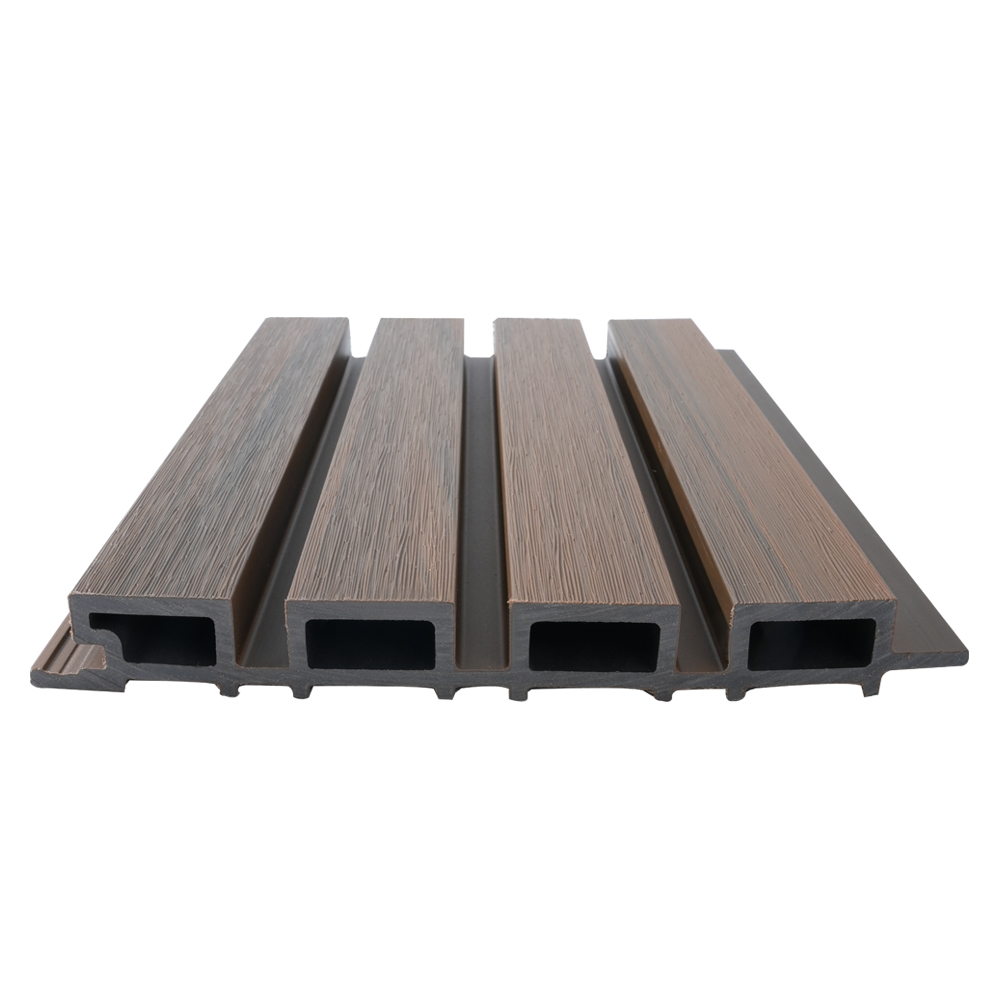 Double-Sided Co-Extruded Great Wall WPC PanelFeaturing a usable finish on both sides, this WPC panel offers weather and corrosion resistance. It suits partitions, perimeter walls, and facades, as noted in the surrounding discussion.View Product →
As a manufacturer of wood-plastic composite building materials, we have observed that architects increasingly specify WPC when the design calls for the look of wood without the maintenance burden.
Many wall panel failures are caused not by a bad material but by a material being used outside its comfort zone. The problems below account for most of the callbacks on interior wall paneling projects.
The flowchart below summarises the selection logic for a typical wall panel project.
Use the same logic when comparing specific products. If the wall is in a dry living space and the design demands a smooth painted colour, MDF is the rational choice. If the design relies on natural grain and you can wait for a refinishing cycle, solid wood is worth the premium. If the wall faces rain, sun, or constant humidity, WPC removes the compromise entirely.
Neither material is ideal in a continuously wet bathroom. MDF swells quickly if water reaches an unsealed edge, and solid wood can warp when repeatedly splashed. If the bathroom is well ventilated, moisture-resistant MDF with sealed edges may work, but WPC or cement-based boards are safer alternatives.
MDF. Its homogeneous, grain-free surface absorbs paint evenly and dries without the raised grain that appears when painting raw wood. Wood can be painted too, but you need extra coats and heavy primers to achieve the same flat result.
Solid timber requires longer growing time, more processing stages, and yields lower material volume per log. MDF uses recycled fibre and high-throughput manufacturing, which lowers the price. You are paying for the unique grain and the long-term refinishing potential of wood.
Modern MDF manufactured for interiors meets low-emission formaldehyde standards in most markets. When cutting and sanding, wear a dust mask to avoid inhaling fine particles. After installation, the exposed surface has low long-term emissions and is safe for normal living spaces.
Yes, but only with appropriate grades. Naturally durable species or pressure-treated timber can be used for exterior walls, but every wood installation requires a maintenance schedule of sealing, oiling, or painting. For exterior walls, WPC panels require significantly less upkeep.
The difference between MDF and wood wall panels is ultimately a question of environment, finish, and maintenance. MDF delivers a flawless painted surface at a lower cost, but it cannot survive consistent moisture. Wood provides unmatched natural grain and long repair life, yet it moves with the seasons and asks for regular care. Where both materials struggle, WPC wall panels offer a durable hybrid that keeps the wood-like appearance without the swelling, warping, or refinishing cycles. Match the material to the wall, and the wall will serve you well for decades.

What is WPC Flooring and Why Manufacturers Choose Factory Direct Sourcing When searching for reliable flooring solutions, procurement professionals a...
READ MOREChoosing between MDF and wood wall panels is rarely a simple preference for one material over the other. The right choice depends on the room, the cl...
READ MOREThe Rise of WPC Composite Decking in Today's Market The outdoor living industry has experienced a significant transformation over the past decade. Ho...
READ MOREWood-plastic composite decking has revolutionized outdoor living spaces by combining the aesthetic appeal of natural wood with the durability of mode...
READ MORE
 No. 6, Nanyuan South Road, Tangyang Town Industrial Park, Dongtai City, China
 [email protected]
 +86-17388015349
Copyright © Jiangsu Xuanhui New Material Technology Co., Ltd. All Rights Reserved.Custom Wood Plastic Composite Environmentally Friendly Materials Factory

