

 English
 Español
 عربى
عربىWhat Is Second Generation Co-extrusion Flooring? Second generation co-extrusion flooring is a composite outdoor decking system built with a dual-laye...
READ MORE
Clean air, a human right
Second generation co-extrusion flooring is a composite outdoor decking system built with a dual-layer structure: a structural core and a co-extruded protective shell. The core provides stiffness and load-bearing capacity, while the outer shell delivers weather resistance, color stability and surface texture. For buyers sourcing outdoor decking at scale, second generation co-extrusion flooring has become the default upgrade path from first generation WPC because it solves the two most common field complaints: fading and moisture absorption.
This guide is written for distributors, contractors, project developers and importers who need technical clarity before placing a wholesale order. It covers how the technology works, where it outperforms first generation boards, what drives price, which applications fit best, and how to qualify a supplier without relying on brand claims.
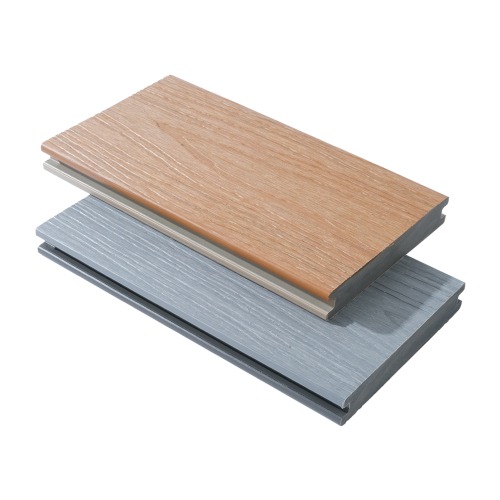
The manufacturing process is the reason performance differs so much from earlier WPC boards. Instead of a single homogeneous mixture, the profile is produced by pushing two materials through one die at the same time.
Core layer: a wood-plastic composite blend of recycled wood fiber and thermoplastic resin. It carries the structural load and accepts standard hidden fasteners.
Co-extrusion shell: a high-polymer protective layer bonded to the core during extrusion. It seals the surface against moisture, UV radiation and staining.
Surface treatment: 3D embossed or brushed wood grain is applied to the shell, giving a realistic timber look without the maintenance of natural wood.
Not every project needs full encapsulation. Single-sided co-extrusion flooring protects the walking surface and the most visible edges, which is sufficient for many residential decks and balcony projects. Double-sided profiles protect both faces and are preferred for raised decks, roof terraces and installations where the underside may be visible.
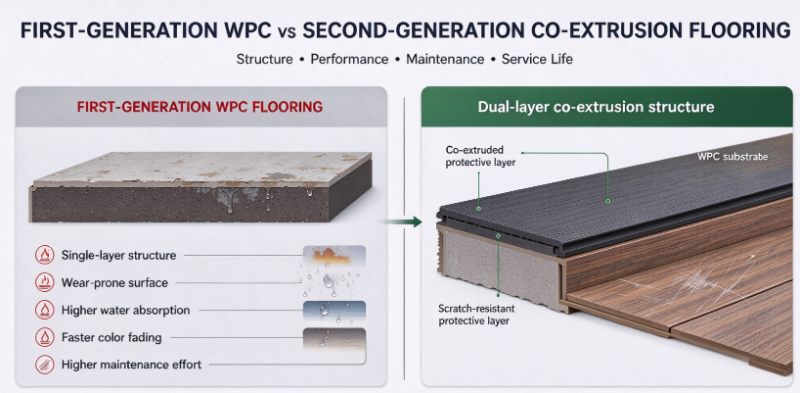
The comparison below reflects typical field performance rather than laboratory best-case numbers. It is the core reason buyers move from first generation boards to second generation profiles.
| Factor | First generation WPC | Second generation co-extrusion |
|---|---|---|
| Surface protection | None or thin coating | Bonded polymer shell |
| Water absorption | Higher, swelling risk | Below 0.5 percent |
| UV fading | Noticeable within 1 to 2 years | Minimal over 10 years |
| Stain and mold | Porous, absorbs stains | Non-porous, easy to clean |
| Maintenance | Regular sealing or oiling | Soap and water only |
| Typical lifespan | 8 to 12 years | 15 to 25 years |
Feature lists are easy to write. The benefits below are the ones that change project economics and reduce after-sales complaints.
The co-extruded shell prevents water from reaching the wood fiber core. This matters most around pools, spas and coastal installations where splash and humidity are constant. Boards do not swell, warp or grow mold in normal outdoor exposure.
Color fade is the number one warranty claim for outdoor composite decking. The protective shell contains UV stabilizers that slow pigment breakdown. In accelerated weathering tests, second generation boards typically retain over 90 percent of their original color after 3,000 hours of exposure.
No sanding, no sealing, no annual oiling. Cleaning is limited to sweeping and occasional washing. For hotels, resorts and public walkways, this reduces lifecycle cost significantly compared with timber or first generation composites.
Embossed surfaces provide reliable traction even when wet. The texture also removes the flat plastic look that made early WPC boards unpopular with architects and landscape designers.
The core uses recycled wood fiber and recyclable thermoplastic. Boards can be reprocessed at end of life, which supports green building documentation and LEED-oriented projects.
Solid profiles carry higher loads and are preferred for commercial walkways, pool surrounds and high-traffic areas. Hollow profiles reduce weight and freight cost, making them suitable for residential decks and balcony projects. The solid WPC decking range covers both options so buyers can match the profile to the load case rather than over-specifying.
Application fit is usually determined by traffic, moisture exposure and whether the underside is visible.
Residential patios and terraces: hollow or solid profiles with single-sided co-extrusion.
Pool decks and spa surrounds: solid profiles with double-sided protection and anti-slip embossing.
Garden walkways and pathways: hollow profiles where load is light and drainage is good.
Commercial promenades and boardwalks: solid profiles with hidden fastening for high traffic.
Hotel and resort projects: consistent color batches and matching fascia boards.
Public parks and viewing platforms: solid profiles with enhanced slip resistance.
Selection rule: if the deck is raised more than 300 mm or receives constant foot traffic, specify a solid co-extruded profile. If weight and freight cost dominate the budget, a hollow profile is usually sufficient for residential use.
Wholesale price is not a single number. It moves with profile design, order volume, surface treatment and delivery terms. Understanding these variables helps buyers compare quotations on equal terms.
| Variable | Effect on price | Buyer action |
|---|---|---|
| Solid vs hollow profile | Solid uses more material | Match profile to load |
| Dimension and thickness | Larger profiles cost more | Confirm span and joist spacing |
| Surface finish | 3D embossed adds processing | Choose texture by application |
| Order quantity | Higher volume lowers unit cost | Consolidate project phases |
| OEM and ODM customization | Color, logo, packaging add cost | Confirm artwork early |
| Shipping and FOB terms | Freight and port charges vary | Compare on FOB basis |
To receive a usable quotation, provide the following: profile type, dimensions, surface finish, color reference, quantity in meters or pieces, project location and required delivery date. Suppliers who ask for these details before quoting are usually the ones with real production planning capability.
Quotation shortcut: send your size, quantity and color requirement. A factory with in-house extrusion and embossing can return a competitive FOB quotation and catalog within 12 hours.
Supplier quality determines whether the second generation board you sell performs as expected five years later. These checks filter out trading companies and low-grade extruders.
Ask for a cross-section sample. A thin or uneven shell is the most common failure point. The protective layer should be uniform around the profile and bonded without gaps.
ISO 9001 quality management
UV and weathering test reports
Slip resistance test data
Load and deflection test reports
Recycled content documentation
Buyers who need custom colors, embossing patterns, branded packaging or private-label lengths should confirm that the factory controls extrusion, embossing and packing in-house. Outsourcing any of these steps usually adds lead time and quality risk.
Ask for monthly output in meters, number of extrusion lines and typical lead time for a repeat order. A factory that can quote a firm delivery window is safer than one that only promises fast shipping.
Request a full-size sample, not a small chip. A 300 mm section shows the actual surface texture, color and edge finish. Testing a sample before a container order is standard practice for serious importers.
Factories with in-house tooling, multiple extrusion lines and documented quality systems are better positioned to support long-term wholesale programs than suppliers that only assemble or resell boards.
Regular first generation WPC is a single-layer composite. Second generation co-extrusion flooring adds a bonded protective shell around the core. The shell blocks water, slows UV fading and makes the surface non-porous, which extends service life and reduces maintenance.
In normal outdoor exposure, a quality co-extruded board lasts 15 to 25 years. Actual life depends on climate, traffic, installation quality and whether the correct profile is used for the load case.
Yes. The waterproof shell and anti-slip texture make it suitable for pool surrounds and spa decks. Use a solid profile with hidden fasteners and ensure proper drainage and ventilation underneath.
It installs with standard hidden clip systems on joists. Boards can be cut with normal woodworking tools. Installation is similar to first generation composite decking, but expansion gaps and joist spacing must follow the supplier specification.
MOQ varies by profile and color. For standard colors and profiles, many factories accept one 20-foot container. Custom colors and private-label packaging usually require a higher minimum. Confirm MOQ together with lead time and sample availability.
Yes. Most factories offer a color range and can match a customer-provided sample for OEM orders. Custom embossing patterns and branded packaging are also available, but they usually increase MOQ and production time.
Second generation co-extrusion flooring solves the practical weaknesses of first generation WPC: fading, water absorption, staining and high maintenance. For wholesale buyers and project specifiers, it offers a longer service life and lower lifecycle cost, which matters more than the initial board price.
When comparing suppliers, focus on co-extrusion layer quality, test documentation, OEM capability, production capacity and sample support. These factors separate factories that can support repeat wholesale programs from those that only sell one-off orders.
If you are sourcing second generation co-extrusion flooring for wholesale or project use, send your required size, quantity and color requirement. A factory with in-house extrusion can provide a catalog, sample and competitive quotation within 12 hours.

What Is Second Generation Co-extrusion Flooring? Second generation co-extrusion flooring is a composite outdoor decking system built with a dual-laye...
READ MOREWhy Outdoor Decking Fails Earlier Than Expected Many outdoor floors look fine on the day they are installed, then start to show problems within a fe...
READ MOREWall panels have become one of the most popular cladding solutions in modern renovation. Homeowners, contractors, and first-time DIYers are drawn to ...
READ MORECan I install wall panels in a bathroom? The short answer is yes, provided you choose a moisture-resistant panel, prepare the wall correctly, and sea...
READ MORE
 No. 6, Nanyuan South Road, Tangyang Town Industrial Park, Dongtai City, China
 [email protected]
 +86-17388015349
Copyright © Jiangsu Xuanhui New Material Technology Co., Ltd. All Rights Reserved.Custom Wood Plastic Composite Environmentally Friendly Materials Factory

