

 English
 Español
 عربى
عربىWhy Outdoor Decking Fails Earlier Than Expected Many outdoor floors look fine on the day they are installed, then start to show problems within a fe...
READ MORE
Clean air, a human right
Many outdoor floors look fine on the day they are installed, then start to show problems within a few seasons. Solid timber can warp, check, and grey under constant moisture. Standard wood-plastic composite boards often hold up better, but in humid coastal air, direct pool splash, or heavy freeze-thaw cycles, they can swell at the joints, fade under strong ultraviolet exposure, and develop surface mold when drainage is poor.
This is where aluminum plastic co-extrusion decking has begun to attract attention from contractors, landscape designers, and importers. The material pairs a structural aluminum alloy core with a co-extruded polymer wear layer, creating a board designed to resist the failure modes that shorten the life of conventional outdoor surfaces.
This guide explains how the material is built, where it performs well, how it compares with other decking options, and which purchasing factors matter most when you request a quotation or sample from a manufacturer.
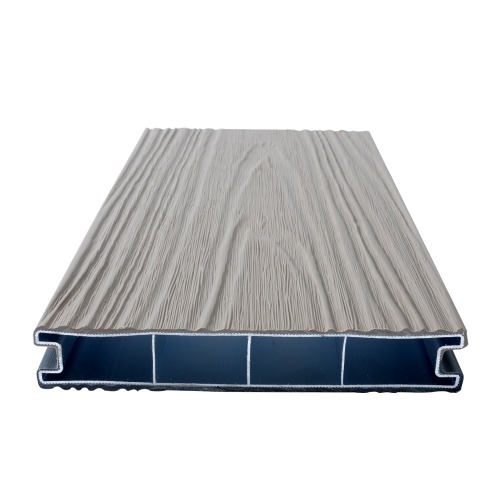
The term describes a multi-layer board in which a hollow aluminum alloy profile forms the structural spine, and a polymer outer layer with a wood-grain surface is extruded directly onto it in one continuous process. Because the layers are formed together rather than glued, there is no adhesive line to delaminate under moisture or thermal stress.
During production, molten polymer and the aluminum profile are brought together in a single forming line. The polymer bonds to the metal surface as it cools, producing a board where the core and the skin behave as one unit. Manufacturers typically control three variables closely: the thickness of the polymer skin, the wall thickness of the aluminum core, and the cooling rate, which determines how stable the board will be after installation.
Compared with ordinary wood-plastic boards, the aluminum core adds rigidity and reduces sag between joists. Compared with aluminum composite panels used for facades, the co-extruded polymer skin provides a walkable, slip-tested surface rather than a rigid cladding face, which is what makes it suitable for floors.
Buyers usually evaluate outdoor materials against a short list of failure modes. The following benefits address the most common ones, and each can be checked against a test report or a field reference during supplier selection.
The sealed aluminum core and continuous polymer skin limit water absorption. This matters most in pool surrounds and coastal sites, where repeated wetting is the primary cause of board swelling in other materials.
Termites and wood-boring insects have no food source in the core or skin. The metal core also avoids the rot pathways that develop in organic materials after prolonged dampness.
Routine care usually involves rinsing with clean water and an occasional soft brush. Staining, sanding, and resealing cycles that typically recur every one to two years for timber are generally not required.
Formulations with UV stabilizers reduce colour shift and surface chalking under long sun exposure. Dimensional change across temperature swings is lower than with many composite boards because the aluminum core limits expansion.
Fire performance: Products rated B1 in common testing frameworks have flame-retardant additives that slow ignition and limit spread, which is relevant for public walkways and hospitality venues.
Slip resistance: Embossed surfaces are commonly tested for wet slip values, a practical criterion for poolside and ramp applications.
Recyclable content: Many manufacturers use recycled polymer and aluminum in their feedstock, and the metal core is widely recyclable at end of life.
Formaldehyde-free composition: Because no resin binders are used in the core, emissions concerns that apply to some engineered woods do not arise.
Selection depends on exposure conditions more than on appearance alone. The table below groups common project types by their dominant environmental stress.
| Project Type | Main Environmental Stress | Why It Suits Co-Extruded Decking |
|---|---|---|
| Residential balcony and terrace | Rain, sun, and occasional standing water | Sealed skin and core resist water absorption |
| Poolside and hot spring area | Constant wetting and chlorinated splash | Corrosion-resistant structure and slip-tested finish |
| Coastal walkway | Salt-laden air and high humidity | Metal core avoids rot and salt-driven degradation |
| Public park or plaza | Heavy foot traffic and fire code requirements | Wear-resistant surface with fire-retardant grade |
| Hotel or guesthouse outdoor floor | Frequent cleaning and appearance expectations | Low-maintenance finish with stable colour |
In coastal projects reviewed by installers, the most frequent early complaint with timber was joint swelling within the first two wet seasons. Boards with sealed aluminum cores showed far fewer joint issues over comparable periods.
A side-by-side view helps clarify where each material fits. The figures below reflect typical ranges reported across the industry and should be verified with each supplier's own test data.
| Criterion | Co-Extruded Aluminum Decking | Ordinary WPC Decking | Solid Timber Decking |
|---|---|---|---|
| Moisture resistance | Excellent | Moderate | Low |
| Pest resistance | High | Partial | Low |
| Maintenance frequency | Very low | Moderate | High |
| Fire performance | B1 grade available | Varies | Typically poor |
| Coastal suitability | Strong | Limited | Poor |
Under normal residential and commercial use with proper drainage and routine cleaning, service lives of ten to twenty years are commonly reported. Actual performance depends on sun exposure, the quality of the substructure, and whether the board is installed with adequate expansion gaps.
Yes, the sealed structure and metal core make it a strong option for coastal sites. Rinsing the surface periodically with fresh water helps remove salt deposits and keeps the finish looking consistent over time.
For public and commercial projects, a B1 flame-retardant grade is a common requirement. Always confirm the test standard and report number with the supplier, because local building codes may specify additional criteria.
Board thickness, surface pattern, colour selection, order volume, and custom specifications all influence cost. Providing your project area, delivery location, and required finish allows a supplier to prepare a more accurate estimate.
Most manufacturers offer sample sets so buyers can check colour, texture, and profile before committing. Sample policies, including whether freight is charged, vary by supplier and should be confirmed during the initial inquiry.
Many production facilities offer OEM and ODM services, including custom profiles, colour matching, and branded packaging. Ask for a prototype run and written confirmation of tolerances before the full production order is released.
Outdoor decking is a long-term investment, and the cheapest initial option often becomes the most expensive over a full service life. Aluminum plastic co-extrusion decking addresses the moisture, pest, and maintenance problems that shorten the life of timber and standard composite boards, making it a practical choice for homes, hotels, parks, and coastal developments.
To move from research to purchase, prepare a short project brief covering area, exposure conditions, desired colour, and expected order volume. Share that brief with a manufacturer, request samples and test documentation, and compare quotations on the same specification. For a full product overview and current quotation options, visit the product page for aluminum plastic co-extrusion decking.

Why Outdoor Decking Fails Earlier Than Expected Many outdoor floors look fine on the day they are installed, then start to show problems within a fe...
READ MOREWall panels have become one of the most popular cladding solutions in modern renovation. Homeowners, contractors, and first-time DIYers are drawn to ...
READ MORECan I install wall panels in a bathroom? The short answer is yes, provided you choose a moisture-resistant panel, prepare the wall correctly, and sea...
READ MOREWhen you search for a "wpc factory" online, you are not just looking for any supplier. You are hunting for a partner who can deliver consistent qual...
READ MORE
 No. 6, Nanyuan South Road, Tangyang Town Industrial Park, Dongtai City, China
 [email protected]
 +86-17388015349
Copyright © Jiangsu Xuanhui New Material Technology Co., Ltd. All Rights Reserved.Custom Wood Plastic Composite Environmentally Friendly Materials Factory

