

 English
 Español
 عربى
عربىWhy Outdoor Decking Fails Earlier Than Expected Many outdoor floors look fine on the day they are installed, then start to show problems within a fe...
READ MORE
Clean air, a human right
When choosing interior wall cladding materials, two names frequently come up: WPC wall panel and PVC wall panel. Both are popular for residential and commercial spaces, but they differ significantly in composition, performance, and long-term value.
Understanding what each panel is made of explains most of their differences.
| Feature | PVC Wall Panel | WPC Wall Panel |
|---|---|---|
| Main ingredients | PVC + additives | Wood fiber + plastic |
| Surface feel | Smooth, plastic-like | Textured, wood-like |
| Flexibility | More flexible | More rigid |
| Weight per m² | Lighter (2–4 kg) | Heavier (5–8 kg) |
| Recyclability | Limited | Better (biobased fraction) |
For long-term use, both materials resist water well, but in different ways.
PVC panels are fully waterproof and do not absorb moisture. They work perfectly in bathrooms, kitchens, or basements. However, they can warp under high heat (above 70°C) and become brittle in freezing conditions over many years. UV exposure without a protective layer causes yellowing and surface degradation.
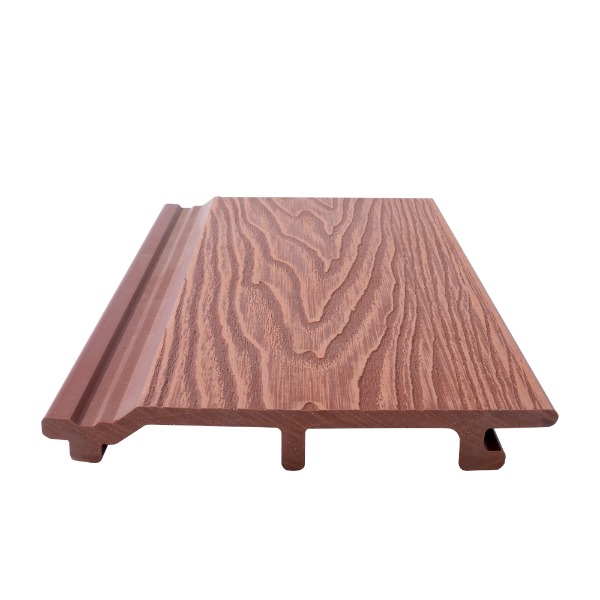
WPC wall panel offers higher structural stability. The wood fibers give it screw-holding strength and resistance to impacts. Modern WPC panels include UV-resistant caps or co-extruded layers, solving earlier problems.
Key durability takeaway: For high-humidity areas with heat sources (near ovens or radiators), WPC is safer. For extreme wet zones like shower walls, both work, but PVC may be cheaper initially.
Installation methods overlap but have subtle differences.
Maintenance comparison: Both are easy to clean – soap and water work. PVC can scratch more easily (scratch hardness ~HB pencil). WPC is closer to H pencil hardness. If you plan to frequently lean or bump against walls (corridors, garages), WPC hides wear better.
A major reason people choose WPC wall panel is its visual similarity to real wood.
Here is a common misconception – both resist water, but mold can grow on the surface of either if dust and humidity linger.
PVC is non-porous. Mold cannot grow inside it, but condensation on the surface supports mold on dust layers. Cleaning is easy.
WPC wall panel absorbs less than 3% moisture by weight (modern versions). The wood fibers are encapsulated in plastic, so mold cannot feed on the inner material. Current WPC uses anti-fungal additives.
Conclusion for wet areas: Both are suitable. For steam rooms or indoor pools, WPC’s tighter dimensional stability is preferred. For budget rental bathrooms, PVC suffices.
Eco-conscious buyers ask about carbon footprint and recyclability.
Without concrete numbers, we discuss relative cost structure.
| Cost Factor | PVC Wall Panel | WPC Wall Panel |
|---|---|---|
| Material price | Lower | Moderate to higher |
| Installation speed | Fast | Moderate |
| Expected lifespan (indoor) | 8–12 years | 15–20+ years |
| Replacement frequency | More often | Less often |
Q1: Can I use PVC wall panel or WPC wall panel in a sauna?
No. Sauna temperatures (80–100°C) exceed both materials’ tolerance. Use untreated wood or specialized sauna cladding.
Q2: Which panel is better for exterior covered patios?
Modern capped WPC wall panel is better. PVC becomes brittle in cold and soft in direct sun. For exteriors, search for “weather-resistant WPC cladding” or “UV-stabilized wood composite panel.”
Q3: Are there any fire safety differences?
Both are combustible. PVC releases hydrogen chloride gas when burning. WPC produces less toxic smoke but still burns. Look for panels with Class B or C fire ratings depending on local codes. Neither should be used in emergency exit corridors without fire-retardant additives.
Q4: Can I paint over them?
PVC needs special adhesion primer. WPC accepts water-based acrylic paints after light sanding. However, painting voids warranty for most decorative surfaces.
Q5: Which is easier to repair if scratched?
PVC scratches are visible as white lines. You can use a heat gun cautiously to blend edges. WPC scratches can be sanded lightly (400-grit) and rewaxed, similar to real wood.
Choose PVC wall panel if:
Choose WPC wall panel if:
In summary, both products have valid uses, but WPC wall panel increasingly leads the market for quality-oriented projects. PVC retains a place in cost-sensitive or temporary applications.

Why Outdoor Decking Fails Earlier Than Expected Many outdoor floors look fine on the day they are installed, then start to show problems within a fe...
READ MOREWall panels have become one of the most popular cladding solutions in modern renovation. Homeowners, contractors, and first-time DIYers are drawn to ...
READ MORECan I install wall panels in a bathroom? The short answer is yes, provided you choose a moisture-resistant panel, prepare the wall correctly, and sea...
READ MOREWhen you search for a "wpc factory" online, you are not just looking for any supplier. You are hunting for a partner who can deliver consistent qual...
READ MORE
 No. 6, Nanyuan South Road, Tangyang Town Industrial Park, Dongtai City, China
 [email protected]
 +86-17388015349
Copyright © Jiangsu Xuanhui New Material Technology Co., Ltd. All Rights Reserved.Custom Wood Plastic Composite Environmentally Friendly Materials Factory

